
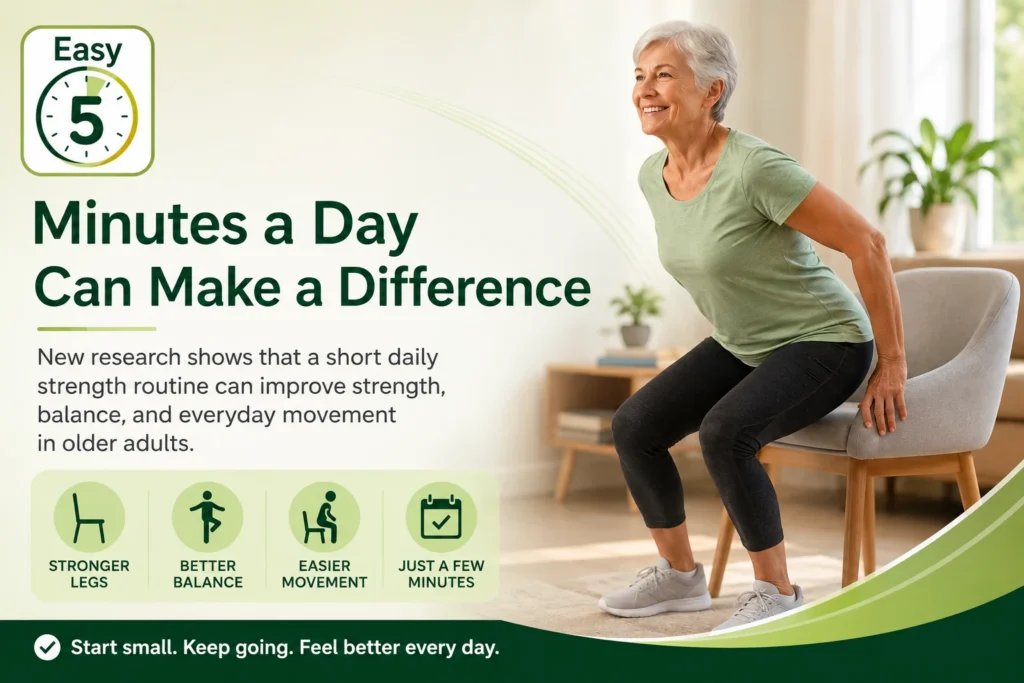
Exercise advice can feel overwhelming.
Walk more. Lift weights. Exercise for 30 minutes. Train several days a week.
That may be good advice, but it also creates a problem: if exercise feels like a big commitment, it becomes easy to do nothing.
A new study suggests there may be another way.
“Improving by just two sit-to-stands in 30 seconds is equivalent to turning back the clock between 10 and 20 years.”
Christopher Sciamanna, Professor of Medicine and of Public Health at Penn State College of Medicine
Researchers tested a simple strength program requiring just 4 minutes per day in older adults who had difficulty walking. After 12 weeks, participants improved their leg strength, balance, and ability to get out of a chair.
The lesson is simple:
You may not need a long workout to start getting stronger.
The 4-Minute Exercise Study
The study, published in PLOS ONE in March 2026, included 97 adults age 65 and older.
The average participant was about 74 years old. Everyone reported difficulty walking a quarter mile, and the group was relatively inactive before the study, averaging only about 18 minutes of physical activity per week. (PLOS)
Researchers divided participants into two groups.
One group continued with their usual activities.
The other completed a short home-based strength program called FAST-2 — Functional Activity Strength Training.
The workout lasted just four minutes.
What Did They Do?
The routine used four familiar exercises:
- Push-ups
- Chair stands
- Seated resistance-band rows
- Step-ups
Each exercise was performed for 30 seconds, followed by 30 seconds of rest.
That meant the workout contained only about 2 minutes of actual exercise, including just 60 seconds of lower-body strength exercise from chair stands and stepping. (PLOS)
Participants were encouraged to do the workout every day.
The exercises could also be modified.
Push-ups, for example, could be done against a wall or kitchen counter. Participants could use their hands to help with chair stands, use lighter resistance bands, or reduce the height of the step.
In fact, exercise modifications were used in about 41% of workout sessions. (PLOS)
That is an important point.
The goal was not to make every exercise difficult. The goal was to make exercise doable.
“We set out to find something that was short enough to be palatable but still be effective, ” said Sciamanna. “Exercise doesn’t have to be lengthy to make a difference. There’s a much more time-efficient way to exercise.”
What Happened After 12 Weeks?
The results were surprisingly strong.
Researchers tested three abilities that matter in everyday life:
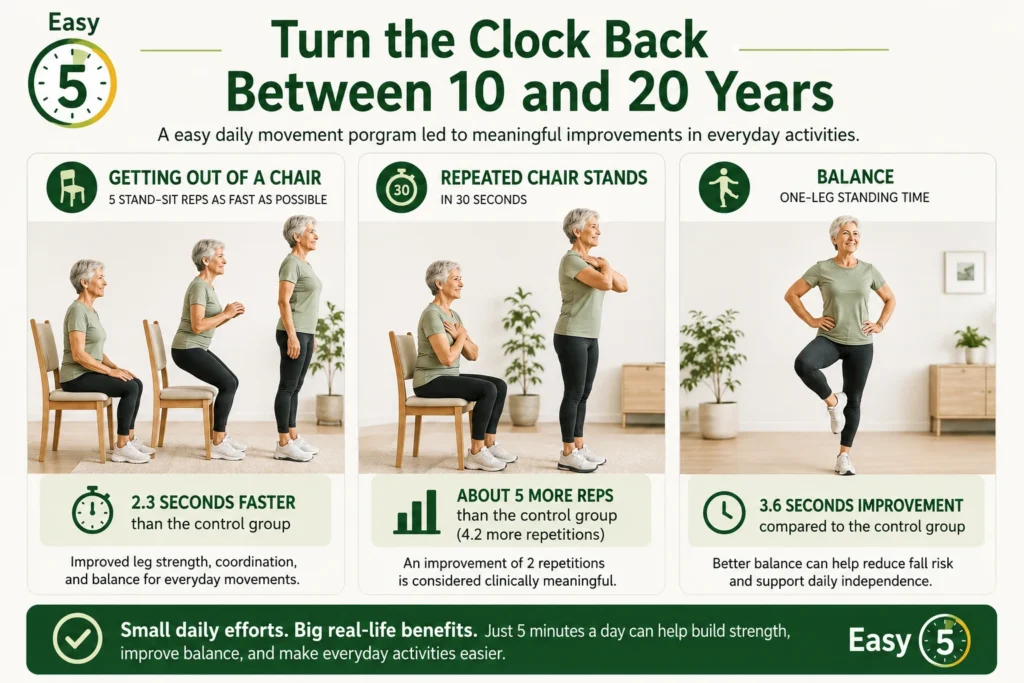
Getting Out of a Chair
Participants performed a test where they had to stand up and sit down five times as quickly as possible.
After 12 weeks, the exercise group completed the test about 2.3 seconds faster than the control group. (PLOS)
Getting out of a chair may sound simple, but it requires leg strength, coordination, and balance.
Those are the same abilities you use when getting off the sofa, getting out of a car, or rising from a toilet.
Repeated Chair Stands
Researchers also measured how many times participants could stand up from a chair in 30 seconds.
The exercise group improved by about five chair stands, compared with less than one additional stand in the control group.
The difference between the groups was about 4.2 repetitions. (PLOS)
The researchers noted that an improvement of two repetitions is considered clinically meaningful, so this was more than simply a measurable statistical change. (PLOS)
Balance
Participants were also tested on how long they could stand on one leg.
The exercise group improved its one-leg standing time while the control group’s performance declined slightly.
The difference between the groups after 12 weeks was approximately 3.6 seconds. (PLOS)
For someone already experiencing mobility difficulties, a few extra seconds of balance can matter.
Perhaps the Most Interesting Result: People Actually Did It
An exercise program cannot help much if nobody follows it.
That is where short workouts may have a major advantage.
Participants completed the FAST-2 workout on approximately 81% of study days — an average of 5.6 days per week. (PLOS)
That is unusually good adherence for an exercise program.
Previous research cited by the study found average adherence of about 67% for home exercise programs aimed at older adults with mobility problems. (PLOS)
Four minutes apparently felt manageable enough to repeat.
And repetition matters.
A modest exercise performed consistently can potentially accomplish more than an ambitious workout that you rarely do.
Why Can Such a Small Amount of Exercise Work?
More exercise is not necessarily useless.
But the relationship between exercise and improvement is not perfectly linear.
The first small amount of training can produce a surprisingly large percentage of the potential benefit.
The researchers point to previous strength-training research suggesting that the first few sets of exercise performed each week can produce much of the strength improvement associated with higher training volumes. (PLOS)
Think of it this way.
Going from:
nothing → a little
may matter much more than people realize.
You do not necessarily have to go from:
nothing → a full gym program.
That distinction is especially important for people who are inactive, older, dealing with limited mobility, or simply intimidated by exercise.
“Exercise is the key to freedom,” Sciamanna said. “Freedom is the ability to be able to do what you want to do, and I would say that if you can’t do what you want to do, you’re not free. I approach exercise by thinking of what I want to be able to do in 20 years, and then I train to do that.”
Everyday Strength Matters
The exercises in this study were not chosen to make people better at bodybuilding.
They practiced movements people actually use.
A chair stand is basically getting out of a chair.
A step-up resembles climbing stairs.
A push-up trains pushing strength.
A row strengthens muscles used for pulling and posture.
This is called functional strength because the strength you develop can help you perform everyday movements.
For many people, that is the kind of strength that matters most.
Being able to:
- rise from a chair
- climb stairs
- maintain your balance
- carry groceries
- walk more confidently
- get up and down more easily
can have an enormous effect on independence and quality of life.
Make Exercise Easy Enough to Repeat
There is another lesson hidden in the study.
Participants did not simply receive four exercises and get left on their own.
They received brief video coaching at the beginning of the program and again during weeks 2, 4, and 8.
They also received daily email reminders and regular feedback about their progress. (PLOS)
Progressions were gradual.
If a regular push-up was too difficult, participants could use a wall.
If a chair stand was difficult, they could use their hands.
If stepping was challenging, they could use a lower step and support.
The program met people where they were.
That can be a better approach than waiting until you feel fit enough to exercise.
Start with the version you can do today. Then gradually make it harder.
Four Minutes Is a Starting Point — Not a Magic Number
There is an important limitation to this research.
The study does not show that four minutes of exercise gives you everything you need for good health.
The researchers specifically caution against that interpretation.
The study lasted only 12 weeks and included a relatively small group of adults over 65 who already had difficulty walking.
It also did not test whether four minutes improved cardiovascular health or body composition.
The researchers concluded only that this brief daily strength routine improved measures of functional performance in this particular population. (PLOS)
Longer-term research is still needed.
So the message is not:
Four minutes is all the exercise you will ever need.
The more useful message is:
Four minutes may be enough to start making progress.
A Simple Way to Start
You do not need to copy the study exactly.
Instead, take the principle behind it.
Choose a few simple movements that use your major muscle groups.
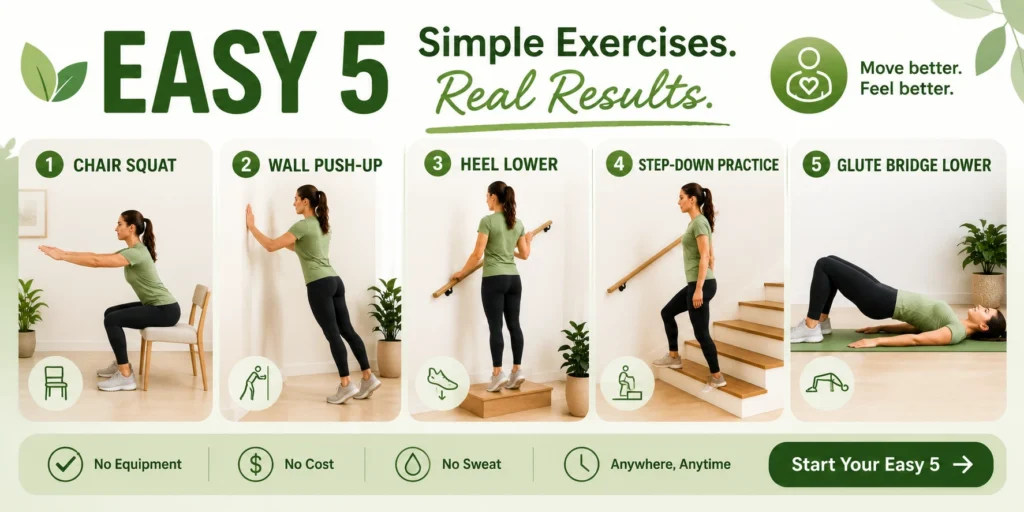
For example:
Chair sit-to-stand
Sit in a sturdy chair. Stand up, then sit down under control.
Wall push-up
Place your hands against a wall. Lower yourself toward the wall and push away.
Supported step-up
Hold a railing or stable counter and step onto a low step.
Supported heel raise
Hold a counter, rise onto your toes, then slowly lower yourself.
Start with an amount that feels manageable.
You might do each exercise for only 20 or 30 seconds.
Rest when you need to.
Good form matters more than doing lots of repetitions.
If you have significant balance problems, cardiovascular disease, major joint problems, recent surgery, or another medical condition that could affect exercise safety, talk with an appropriate healthcare professional before starting.
Start Small. Keep Going.
One of the biggest barriers to exercise is the belief that it has to be a workout.
It has to take 30 minutes.
It has to make you sweat.
It has to be difficult.
It has to happen in a gym.
This study challenges that assumption.
A group of older adults with existing mobility difficulties completed a few simple exercises at home for only a few minutes each day.
Twelve weeks later, they were better at standing up, balancing, and performing everyday movements. (PLOS)
That is a useful reminder for almost anyone trying to become more active.
You don’t have to start big.
Start easy.
Make the exercise simple enough that you can do it again tomorrow.
Then keep going.
That’s how a few minutes can begin to add up.
Research Source
Dandekar S, Kurth J, Shang Y, et al. Brief daily functional strength training to improve functional performance in older adults with mobility disability: A randomized trial. PLOS ONE. Published March 12, 2026. (PLOS)